Scorri verso il basso per la versione in italiano
 |
| Alex Hanimann, Ohne Titel, 1999-2000. Private collection, Switzerland. |
OVER AND SOME TOUCH OF…
Donato
Amstutz, Katia Bassanini, Anna Choi, Michel Ducerveau, Mauro Ghiglione,
Fabrizio Giannini, Alex Hanimann, Johnnie JungleGuts, Csaba Kis Róka,
Lang/Baumann, Erik Mittasch, Virginia
Monteverde
Vernissage on Saturday
29 August 2015 from 5.30 p.m.
29 August – 8 November 2015
Fri-Sat-Sun from 2.00
to 6.00 p.m.
OVER is an
anthological exhibition that constitutes something of a platform, where artists
who use different languages coexist in a general artistic and aesthetic
panorama in a constant state of flux. Quite apart from those cells that are
still vigorously distinguished by the paradigms of the Avant-garde, whose
nucleus anticipated the figure of an militant artist involved socially and
politically in its evolutionary developments, for the generation of artists who
were born in the sixties and seventies, the concept of irreversibility and of
stylistic consistency has become drastically absent these days.
Some of these
artists feature in OVER, on the one hand to underscore – this is the curator’s
intention – the blurred sense of historical belonging that is now somewhat
dated, while on the other to convey an understanding of the extent to which the
identity of the transition, transmedia and unisexuality of languages has driven
artists and historians to devote attention to a re-examination of history, in
its progressive, evolutionary significance, erecting a major question mark
against the assumptions of the latter half of the last century and elaborating
(and sometimes theorising) Post-Modernity. While some deplore that the trail
was already blazed for a return to traditional academic forms towards the end
of the sixties in the direction of painting, drawing and the plastic arts, on
the other hand this phenomenon – which coincides with a social fallout set free
of ideologies, but not always completely free of nostalgic revivals or forms of
inurement to the image dictated by the “age of reproducibility” – encourages us
to look at the globality of a society in a state of change and growth and to
ponder a phenomenon that has obvious parallels in other areas of
socio-political geography in the environs of art.
It is vitally
important now to look back and reconsider times in history of no great
remoteness, when the relationship between art and the market was in its heyday
and such concepts as fashion, the market and strategies of cultural policy
seemed to be the driving force – and not only in artistic terms – of the art
world. The market in particular used to dictate the rules, transforming the
museum from a place of intellectual intercourse into a customer base for a
critical mass paying for those forms of exhibitions that are often devoid of
representation, but in which the blockbuster concept and the system of approved
curators have replaced – in the majority of such cases – the classical,
traditional universe of thinking and of authenticity.
In the midst of
unrelenting criticism of these often deleterious forms and methods of policy,
some more or less parallel morphologies of artistic creations are coming into
being as a sort of counterbalance, opening up new ways and additional spaces of
discussion, to the point that serious questions are being raised about the
identity and utility of the museum as a place for preserving history and its
memory.
The artists shown
in this exhibition are young: of all of them it can be said that they are to
some extent lifted from their own creative processes and placed in the new
context of a curatorial experience whose matrix is simply anthological. The
passage is one from a conceptual-theosophist experience, that only a handful of
curators was capable of applying to the specifics of a given period in history,
to the simply visual, sensorial and analytical experience related the image and
its representation.
Mario Casanova, 2015
[translation Pete Kercher]
 |
| Anna Choi (1979), Untitled, 2014. Oil on canvas. Private collection, Switzerland. |
OVER AND SOME TOUCH OF…
Donato
Amstutz, Katia Bassanini, Anna Choi, Michel Ducerveau, Mauro Ghiglione,
Fabrizio Giannini, Alex Hanimann, Johnnie JungleGuts, Csaba Kis Róka,
Lang/Baumann, Erik Mittasch, Virginia
Monteverde
Vernissage Sabato 29 agosto 2015 dalle 17:30
29 agosto – 8 novembre 2015
Ve-sa-do dalle 14:00 alle 18:00
OVER è una mostra antologica che rappresenta una sorta di piattaforma,
dove coesistono artisti dal linguaggio differenziato all’interno di un panorama
artistico ed estetico generale in continuo cambiamento. Al di là di cellule
ancora fortemente caratterizzate dai paradigmi dell’Avanguardia, al cui centro
si preconizza una figura di artista militante coinvolto socialmente e
politicamente nel suo percorso evolutivo, per quella generazione nata tra gli
anni Sessanta e Settanta oggigiorno il concetto di irreversibilità e di
coerenza stilistica è venuto drasticamente a mancare.
Qualcuno di questi artisti è presente in OVER, da un lato a marcare –
per volontà del curatore – questa labile appartenenza storica ormai datata,
dall’altro per farci capire quanto l’identità del transito, la transmedialità e
l’unisessualità dei linguaggi abbiano spinto gli autori e gli storici a
riflettere sul riesame della Storia, nel suo significato progressivo ed
evolutivo, rimettendo in grande discussione il secondo Novecento ed elaborando
(e talvolta teorizzando) la Post-Modernità. Se per taluni è deplorevole avere
aperto varchi per un ritorno a forme accademiche tradizionali già verso la fine
degli anni Sessanta nella direzione della pittura, disegno e opera plastica,
d’altra parte questo fenomeno – che coincide con un decorre sociale liberato
dalle ideologie, ma non sempre privo di recrudescenze a carattere nostalgico o
forme di assuefazione all’immagine dettate dalla ‘epoca della riproducibilità’
– ci spinge a riflettere, nella globalità di una società in cambiamento e in
crescita, su di un fenomeno che trova ovvi paralleli in altri ambiti della
geografia politico-sociale vicina all’arte.
È quanto mai importante riflettere sui tempi storici non tanto remoti,
ove il rapporto arte-mercato era ai massimi splendori e laddove concetti come
moda, mercato e strategie di politica culturale sembravano essere il motore non
solo artistico del mondo dell’arte. Il mercato in particolare dettò legge,
trasformando il museo da luogo di scambio intellettuale a bacino d’utenza per
una massa critica pagante quelle forme espositive spesso prive di
rappresentazione, ma dove il concetto blockbuster e curatori di regime hanno sostituito –
nella maggioranza di questi casi – il classico e tradizionale universo del
pensiero e dell’autenticità.
Nella critica totale a queste forme e modalità politiche spesso
deleterie, per contro si stanno creando viepiù morfologie parallele di
creazioni artistiche, che aprono nuovi e ulteriori spazi di discussione; tanto
da mettere in seria disquisizione identità e utilità di un museo come luogo di
conservazione della Storia e della memoria storica.
 |
Erik Mittasch (1981), Schälchen (Malachit I), porcelain, 2014.
Private collection, Switzerland. |
Gli artisti presenti in questa mostra sono
giovani e ognuno di loro viene in qualche modo prelevato dal proprio processo
creativo e ricontestualizzato nell’esperienza curatoriale di matrice
semplicemente antologica. Il passaggio da un’esperienza concettuale-teosofica,
che solo pochi curatori seppero fare nello specifico di un periodo storico,
all’esperienza semplicemente visiva, sensoriale e analitica legata all’immagine
e alla sua rappresentazione.
Mario Casanova, 2015
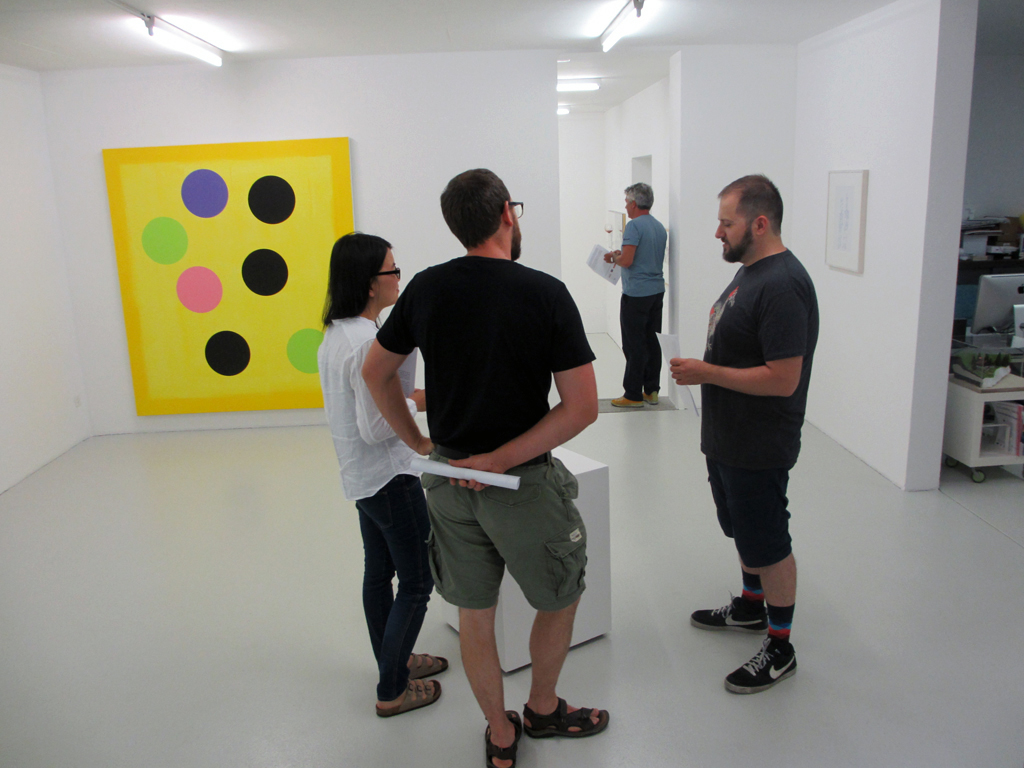
Some visuals of the opening
Ph. Pier Giorgio De Pinto © PRO LITTERIS Zürich, Virginia Monteverde
MACT/CACT Suisse enjoys the financial and cultural support of Republic and Canton of Ticino/Swisslos, City of Bellinzona, Friends of MACT/CACT, the Artists.
MACT/CACT Arte Contemporanea Ticino è sostenuto
finanziariamente e culturalmente da Repubblica e Cantone del Ticino/Swisslos, Città
di Bellinzona, Amici del MACT/CACT, gli Artisti.